
If you’re a brand owner in India, brand distribution control is probably the most frustrating part of scaling online. You’ve worked hard to build a quality product and a trusted brand name — and then you discover it being sold at wrong prices, on the wrong platforms, by sellers you never approved.
Unauthorized selling is one of the biggest threats to Indian brand distribution today. It leads to price erosion, fake product complaints, damaged reputation, and loss of control over your own brand story. See how unauthorized sellers damage brand reputation on Amazon →
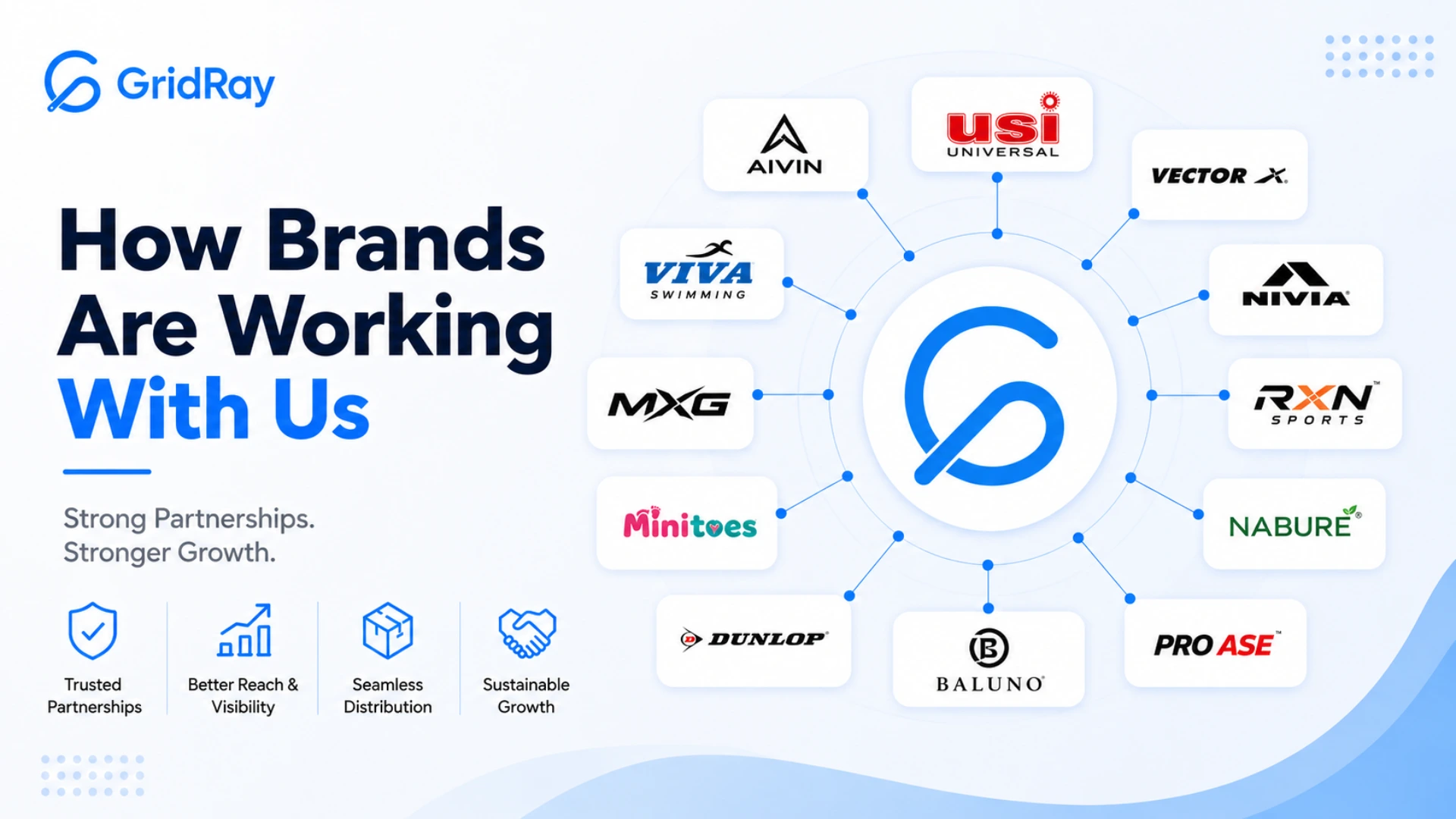
The good news is that controlling your reseller network is possible — and with the right system, it’s not complicated. Brands like Nivia, VectorX, Dunlop, and Slazenger already manage their authorized reseller networks through GridRay.
Why Brands Lose Control of Their Distribution
Most brands distribute products through traditional wholesale channels: a distributor, a few dealers, and then whoever they sell to next. The problem is that once your product leaves your warehouse, you have very little visibility into where it goes.
A dealer in Delhi might sell to a reseller in Surat, who then lists it on Amazon at a price that undercuts your official store. Another seller buys in bulk and floods Flipkart with listings that have wrong images, inaccurate descriptions, and zero after-sales support.
By the time you notice, your brand’s reputation has already taken a hit. This is how brand distribution breaks down — not through a single bad decision, but through a gradual loss of visibility across the channel.
Common Mistakes Brands Make With Distribution
Before looking at the solution, it’s worth understanding how brands typically lose control of their distribution channel in the first place:
- Selling to anyone who places a bulk order without verifying who they are or where they plan to sell
- No written channel policy — resellers don’t know which platforms are allowed, so they sell everywhere
- No MAP agreement — without a minimum price policy, the first reseller to discount starts a chain reaction that drives prices to the floor
- No visibility after the sale — once stock leaves the warehouse, there is no system to track where it ends up or who is listing it online
These aren’t unusual mistakes. They’re the natural result of growing through traditional wholesale without building a distribution structure alongside it. Avoid common legal mistakes that compound these problems →
Choosing the Right Brand Distribution Strategy
Not all distribution strategies work the same way. Understanding the three main approaches helps you choose the one that matches your brand’s goals.
Intensive distribution means selling through as many channels and sellers as possible. It maximizes reach but gives you almost no control over pricing, presentation, or who represents your brand. Fast-moving consumer goods often use this model — but for brands that care about quality and positioning, it’s a race to the bottom.
Selective distribution means partnering only with approved, vetted resellers who meet your criteria. This is the preferred model for most Indian brands serious about brand distribution control. You choose your channel partners, define where they can sell, and set the pricing rules. The Competition Commission of India permits selective distribution agreements when the selection criteria are objective and applied uniformly.
Exclusive distribution assigns a single authorized partner per territory. This maximizes control and is common for premium brands, but limits reach and puts significant dependence on a small number of partners.
For most Indian brands selling on Amazon, Flipkart, and through social commerce channels, selective distribution is the right model — enough reach to grow, with the structure to protect your brand.
The Legal Side: Selective Distribution in India
Indian competition law under the Competition Act, 2002 allows brands to restrict who sells their products through selective distribution agreements — provided the criteria for selection are objective, transparent, and applied uniformly. You can require resellers to meet quality standards, maintain minimum service levels, and sell only through approved channels.
What is not permitted is fixing the actual resale price. You cannot legally mandate the exact price a reseller charges customers. However, Minimum Advertised Price (MAP) policies — which restrict the advertised price rather than the actual transaction price — are widely used and structured to protect brand value without crossing into price-fixing territory.
This distinction matters when you are setting up your reseller agreements. If your channel policy includes pricing terms, consult a legal advisor familiar with Indian competition law before finalizing.
The Three Things You Actually Need to Control
Real brand distribution control in India comes down to three things:
1. Who is authorized to sell your products You need a system where only approved, vetted resellers can access your catalog and place orders — not just anyone who finds your products on a wholesale market. Learn how authorized reselling works legally in India → Rigorous reseller vetting before onboarding is what separates a structured reseller network from an open wholesale free-for-all. How to vet new resellers before approving them →
2. Which channels they can sell on Some brands want their products only on Amazon and Flipkart. Others are fine with Instagram resellers but not on grey-market platforms. You should be able to define this channel policy clearly and enforce it.
3. At what price they sell Brands can suggest a Minimum Advertised Price (MAP) to authorized resellers, helping prevent undercutting and protecting the perceived value of their products across all channels.
Brand Authorization on Amazon and Flipkart
One of the most common points where brand distribution breaks down is on India’s major marketplaces. Amazon and Flipkart both allow third-party sellers to list products — and without a brand authorization system in place, anyone who sources your product through grey-market channels can create a listing under your brand name.
Amazon India’s Brand Registry program gives you tools to claim ownership of your brand on the platform, report unauthorized listings, and monitor sellers who misuse your brand name. Flipkart has an equivalent Brand Protection program. Enrolling in both is a baseline requirement for any Indian brand serious about controlling its online distribution.
But marketplace registration alone is not enough. The real control comes from having a locked reseller network upstream: if every seller in your channel is an approved reseller with access through a controlled platform, grey-market listings lose their supply source. There is no legitimate stock for an unauthorized seller to draw from.
Your authorized resellers receive a GST-compliant invoice with every order, issued by GridRay on behalf of your Order Processing Centre (OPC) — giving them the documentation they need to meet marketplace compliance requirements. GST compliance for online sellers in India →
Reaching Tier-2 and Tier-3 Markets Without Losing Brand Control
One of the hardest challenges in Indian brand distribution is geographic scale. Your brand may have solid distribution in Mumbai and Delhi, but reaching Jaipur, Indore, Coimbatore, or Nagpur typically means adding more distributors — and every new distributor added through traditional wholesale is another potential gap in your control structure.
GridRay solves this differently. Because resellers operate digitally and carry no inventory, a reseller in any city can list and sell your products on the channels you authorize, without you needing a local warehouse or local distribution appointment. Orders are fulfilled from your central authorized warehouse and delivered through GridShip to the end customer.
This means your reseller network can scale into tier-2 and tier-3 cities without the control loss that comes with traditional multi-tier wholesale. See how GridRay’s model compares to dropshipping →
How GridRay Gives Brands Full Distribution Control in India
GridRay is built specifically to solve the authorized brand distribution problem for Indian brands. Here is how it works in practice:
Gated access for resellers
When a reseller applies to join your authorized network on GridRay, they must get approved by you. You can set the criteria — business type, platform, certifications, or any other requirement. Only approved resellers can access your catalog. This is 100% authenticated and authorized access — no unauthorized seller can list your products through the platform.
Channel-specific permissions
GridRay lets you define exactly which channels each reseller is allowed to sell on. You might approve a reseller to sell on Instagram but not on Amazon. Another reseller might be approved for Flipkart only. This gives you precise, channel-level control over your distribution.
Minimum Advertised Price (MAP) support
Brands can suggest a Minimum Advertised Price to authorized resellers, helping protect offline distribution investments from online undercutting. GridRay communicates the brand’s MAP guidance to resellers during onboarding — the pricing decision rests with the brand, not the platform.
Resellers pay dealer price only after they make a sale
Unlike traditional wholesale where you push inventory onto channel partners upfront, GridRay’s zero-inventory model means resellers pay dealer price only after a customer places an order. Stock moves on demand from your warehouse — which means more resellers are willing to list and actively sell your products, expanding your reseller reach without forcing anyone to carry stock.
Same-day dispatch from your authorized warehouse
Orders placed before 12 PM (noon) are typically dispatched same-day directly from your brand-authorized warehouse. Your customers receive genuine, well-packaged products with fast delivery — protecting your brand experience at the last mile.
One fulfillment point
Because GridRay handles fulfillment from your authorized warehouse, every order passes through a single controlled point. There is no parallel stock flowing through uncontrolled channels.
Full visibility
You can see who is selling your products, on which channels, and in what volumes. This visibility is something traditional brand distribution simply cannot offer.
What This Means for Your Brand in Practice
When a customer searches for your brand on Amazon, they find listings from authorized sellers with correct product images, accurate descriptions, and proper pricing. When they receive the product, it comes from your warehouse — genuine, well-packaged, and exactly as described.
Your distribution network is protected at every step.
Consider what this looks like without a system like this: a customer finds your brand on Flipkart, buys from an unauthorized seller, receives a poorly packaged product with no warranty support, and leaves a one-star review under your brand name. You had nothing to do with that sale — but your brand paid the price for it.
For brands that are serious about building long-term equity in the Indian market, brand distribution control is not optional — it is foundational.
Getting Started with GridRay as a Brand
Partnering with GridRay as a brand is straightforward. You share your product catalog, set your dealer pricing, define your channel policy, and GridRay handles the rest — onboarding resellers, managing orders, processing fulfillment, and keeping your channel management structured.
There are no complex integrations, no large upfront commitments, and no need to rebuild your existing operations. GridRay works alongside your current setup and brings structure to the distribution layer.
Ready to take control of your brand’s distribution? Partner with GridRay → and build an authorized reseller network that works entirely on your terms.