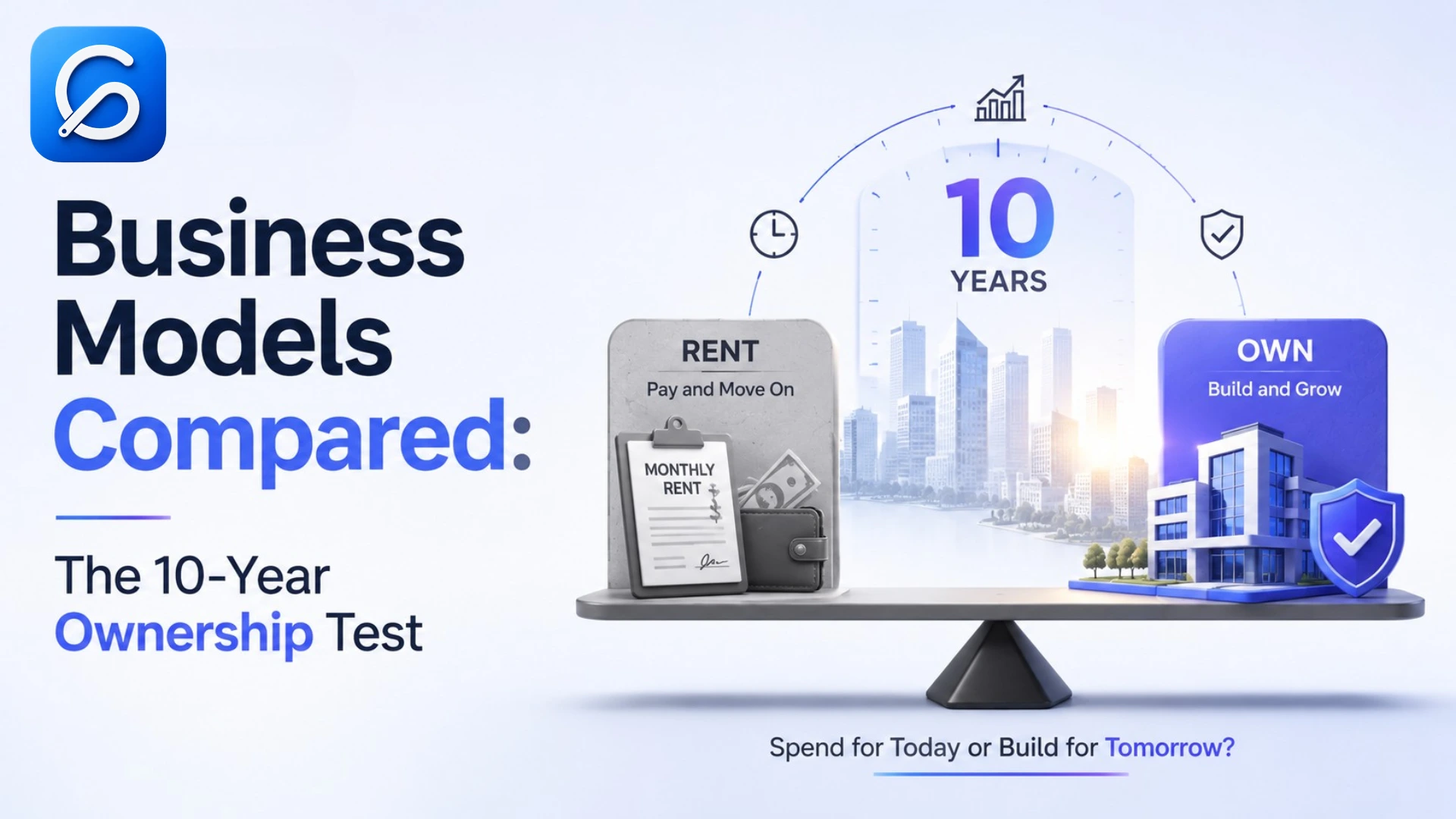
Two sellers do ₹5 lakh a month. Same products, same margins, same balance in the bank at the end of the month.
Ten years in, one of them can hand the business to their son or daughter — or to a buyer — and walk out of the room. The other can hand over a password.
Nothing in the monthly numbers ever showed that difference coming. It was decided by two things neither seller thought of as strategy: where they sold, and how they sourced. Which of the two you’re on course to become depends on where you’re standing right now.
Which Seller Are You?
There’s no universal best model, so start by finding yourself here. The rest of the guide will make more sense once you know which row is yours.
| If this is you | Your real constraint | What to focus on first |
|---|---|---|
| Starting fresh, limited capital | You don’t yet know what sells | Learning demand cheaply — pick a channel that already has buyers, and source without locking up capital |
| Established marketplace seller (₹1L-50L/month) | Platform dependency, thinning margins | Building a second channel — your own site or social — where you can actually own the customer relationship |
| Social seller or creator (audience already built) | Your reach is your ceiling — and it’s rented | Converting followers into a contact list you own, off-platform |
| Own D2C website owner | Full control, but you’re paying for every single visitor yourself | Surviving to repeat-purchase economics before the cash runs out |
| Offline retailer | Geography caps you; capital is tied up in shelves | Adding a channel that extends past your catchment area without adding rent |
| Community or institutional partner (club, gym, school, corporate) | Trust is high, but ordering is irregular | Sourcing that doesn’t punish irregular volumes with dead stock |
Every one of these can be improved. None of them is improved by the same move.
The Two Decisions Most Comparisons Conflate
Before anything else, separate two choices that get mashed together constantly.
Channel is where you sell and who brings you the buyer: a marketplace, a physical store, a social audience, or your own website.
Procurement is how you source and pay for stock: buying it outright, generic dropshipping, or a GridRay-authorized arrangement where a brand approves you to sell its products.
These are independent choices. You can source the same authorized catalog and sell it on a marketplace, on Instagram, or on your own site — the two decisions don’t have to move together, and mixing them up is why so many “which is better” debates in this space go nowhere.
Your channel determines your acquisition cost, your control, and what you ultimately own. Your procurement determines your capital risk, your margin stability, and your product quality.
Get one right and the other wrong and you’ve still built something fragile.
Acquisition Is a Tax Every Channel Pays
No channel has solved the hardest part of selling. What changes isn’t whether you pay to get a customer — you always do — but what form the payment takes, and whether it gets cheaper or more expensive over time.
| Channel | Who brings the buyer | What acquisition costs you | Cost trend over time |
|---|---|---|---|
| Marketplace (Amazon, Flipkart, Meesho, eBay, Walmart, and similar platforms) | Platform aggregates demand | Sponsored ads + commission + price competition | Goes up — more sellers keep joining and competing for the same buyers |
| Offline retail store | Foot traffic + local reputation | Rent (a stand-in for acquisition cost) + local marketing | Goes down — local reputation keeps building the longer you’re there |
| Social selling | Your own audience | Time and content rather than cash | Stays flat, then stops growing — capped by how many people follow you |
| Own D2C site | Nobody — you build demand from zero | Everything: SEO, ads, email, content | Goes down over time — once you survive year one, repeat customers cost nothing to sell to again |
That last column is the one that matters over a decade. Paid acquisition on the major ad platforms has been getting steadily more expensive as more sellers compete for the same clicks, while acquisition through channels you own — email, WhatsApp, organic search, repeat customers — gets cheaper as your list grows. The gap between renting your customers and owning them widens every year.
Notice what isn’t in this table: dropshipping and authorized reselling aren’t here, because they aren’t channels. They’re sourcing methods that sit underneath any row above — covered next.
A Better Question: Which Channel Does Which Job?
Once you see channels this way, you stop asking “which one should I pick” and start asking what each one is good at.
| Channel | The job it does well |
|---|---|
| Marketplaces | Demand capture and fast validation of what sells |
| Instagram, YouTube, WhatsApp | Attention and trust at low cash cost |
| Your own site | Customer ownership and first-party data |
| WhatsApp and email lists | Retention and repeat purchase |
| Offline | Experience, immediacy, and local trust |
| B2B distribution | Selling in bulk through other businesses that resell to their own customers |
Strong operators rarely pick one. They use marketplaces and social to learn what sells and who buys, then deliberately convert that into demand they own — while sourcing in a way that doesn’t tie up the capital they need to fund the transition.
The same idea applies if your buyers aren’t only individual consumers. A repeat institutional account — a gym chain, a school, a corporate gifting order — behaves more like an owned asset than a one-off consumer sale, because it keeps coming back without fresh acquisition spend each time. That’s a real path for community and institutional partners, not just for brands.
What You’re Actually Choosing When You Choose Procurement
However you acquire a customer, you still have to decide how you’ll source what you sell them.
| Sourcing method | Capital required | Main risk | Margin stability | Authenticity control |
|---|---|---|---|---|
| Unverified stock ownership (generic wholesale) | High — you buy before you sell | Dead stock, storage, obsolescence, no recourse on quality | Depends entirely on your own pricing discipline | Variable — you vet the supplier yourself |
| Generic dropshipping | Low — supplier paid after the sale | Supplier reliability, long shipping times, counterfeit exposure | Erodes fast — identical products, race to the bottom | Low — no brand relationship |
| Authorized stock ownership via GridRay (bulk stock delivered to you) | High — you still buy in bulk upfront | Dead stock and storage remain; supplier and authenticity risk removed | Stable — dealer price set by the brand | High — brand-verified products |
| GridRay direct fulfilment | Lowest — pay dealer price for what you’ve already sold, plus shipping | Authorization is channel-specific and subject to brand approval | Stable — same dealer price | High — brand-verified products |
Dead stock is the most common way the first row fails — one seller’s real loss, and the recovery that followed, is documented in Dead Stock Killed My Business.
Zoom out and this table is really about one thing: whether a customer comes back. A product that’s genuine and arrives on time earns a second purchase; one that’s inconsistent — late, wrong, or not what was promised — doesn’t, no matter how good your acquisition was. That’s why procurement is a ten-year decision, not just a cost decision. Building for the long run means a supply chain you can actually trust, at a scale that holds up as you grow: a catalog wide enough to give customers a reason to return, delivery that doesn’t slow down as volume increases, pricing that stays consistent instead of drifting deal to deal, and eventually, reach beyond one city or one country. Scale that only grows the catalog while everything else gets shakier isn’t the kind of scale that compounds.
Three real costs are worth pricing in here, because most comparisons skip them:
Returns. Especially in markets with heavy cash-on-delivery volume, orders returned before delivery are common and expensive — you pay forward shipping, return shipping, and often handling, on an order that generated zero revenue. A business that looks healthy on gross orders can be losing money once this is properly accounted for. Quality drives this more than most sellers admit: generic, unverified goods draw far more returns, and once a customer gets something inconsistent or fake, they don’t just send that order back — they stop trusting you for the next one. Verified, branded products see fewer returns and more repeat purchases, because the customer knows what they’re getting. If you’re not tracking your return rate by payment method and by product source, you don’t yet know your real unit economics. Our ecommerce shipping guide covers carrier-level cost benchmarks.
Tax compliance. Whether your supplier issues a proper GST-compliant invoice changes your effective cost of goods, not just your paperwork — informal sourcing that looks cheaper per unit is often more expensive once you account for input credit you can’t claim. See our GST compliance guide for online sellers for the details.
Fragmented demand. Especially in India, where marketplaces, social commerce, quick commerce and networks like ONDC all carry real volume, buyers are spread across more surfaces than a single channel can capture. Owning a customer contact list early lets you follow buyers across surfaces instead of rebuilding your audience on each one.
Put the table and these three costs together, and the pattern is clear: the weakest procurement pairing is generic dropshipping on a brand-new site with no trust built yet — you’re paying full price for traffic while offering the least reason to buy from you specifically. The strongest is authorized sourcing paired with a channel you’re deliberately building into an asset.
Where Authorized Reselling Fits — Honestly
Reselling authorized brands builds a real asset: a customer base, channel authorizations, supplier relationships, and the operating capability to move products reliably. That’s exactly what this guide has been measuring throughout — not a lesser version of some other business.
Which is where GridRay fits, stated plainly:
GridRay does not solve customer acquisition. No sourcing model does. Acquisition lives at the channel layer, and you still own it.
What it changes is everything after you’ve earned the customer. GridRay is a B2B2C distribution network and authorization platform: brands approve resellers for specific channels, and approved resellers receive an authorization letter issued by GridRay on the brand’s behalf, official product data and images, and a dealer price set by the brand. You set your own retail price. You receive a GST-compliant invoice with every order, issued by GridRay on behalf of the brand’s Order Processing Center — for your own records and input credit, not something sent to your end customer.
It’s authorization-first and fulfilment-flexible:
- Direct fulfilment — you pay dealer price only for what you’ve already sold, plus the shipping cost per order, and the brand’s warehouse dispatches while GridRay manages shipping. Best-effort same-day dispatch for orders placed before 12pm noon.
- Bulk stock — buy in bulk, delivered to your location. If you run an offline store, customers simply come in and take it away; if you’re selling remotely from that same stock, you ship it out yourself.
- FBA — source stock and send it into Amazon’s fulfilment network. Our FBA vs FBM comparison covers when that’s worth the fees.
Direct fulfilment removes capital locked in stock entirely — you don’t pay until it’s already sold. The bulk-stock option still ties up capital the way any inventory purchase does, but removes the counterfeit and unverified-supplier risk you’d carry sourcing independently. Neither option removes your marketing costs, your shipping costs, your customer support, or the work of building an audience — that’s still yours to run either way. Authorization is also channel-specific: a new channel needs its own approval, and a brand may choose not to renew a reseller who isn’t performing.
If you’re comparing this specifically against generic dropshipping, our profit comparison breaks down the unit economics. Against MLM-style networks, see Dropshipping vs MLM vs Authorized Reselling. And if you want the legal grounding for selling branded goods, start with how to sell branded products legally.
The Compounding Effect: Two Sellers, Ten Years
Go back to the two sellers from the top of this guide — same products, same budget, same ₹5 lakh a month.
Seller A lists on a marketplace and optimizes relentlessly — better listings, better ads, better ratings. Every sale follows the same path: platform → order → done.
Seller B also starts on the marketplace, because that’s where the buyers already are. But treats it as a way to fund something else from the beginning: learning which products repeat, then reinvesting the profit into a site and an audience where new buyers become contacts Seller B actually owns.
Year 1: Seller A is clearly ahead. Marketplace demand is real and immediate; building your own audience produces almost nothing at first.
Year 3: They look broadly similar on revenue. Seller B has spent money and effort on things that haven’t obviously paid off yet.
Year 5: The gap starts opening — in the cost of the next sale. Seller A is still buying every customer at rising auction rates. A meaningful share of Seller B’s orders now come from people who already bought once.
Year 10: Seller A owns operating knowledge, supplier relationships, and a strong sales history on one platform. Seller B owns a customer database, a name people search for directly, repeat demand, and more than one way to reach a buyer.
Both can be good businesses. But only one of them can be handed to somebody else — a successor or a buyer — and still work without the person who built it. If Seller B’s path is the one you want, our D2C launch checklist covers the build.
What Actually Compounds
| Model | What accumulates over 10 years |
|---|---|
| Marketplace selling | Sales history and ranking on that platform |
| Offline retail | Location value and local reputation |
| Social selling | Audience and trust |
| Own D2C site | Customer relationships and first-party data |
| Own brand | Brand equity, product IP, pricing power |
| B2B distribution | A dealer and retailer network that can carry new products |
| Authorized reselling | Customer base, channel authorizations, and operating capability |
| Generic dropshipping | Acquisition skill — but little in the product itself |
The Dependency Ladder
There are three levels of dependence, and moving up one is usually worth more than any tactical improvement.
Level 1 — Platform dependency. “The marketplace brings me customers.” Highest exposure: commission changes, ranking changes, or a policy suspension can remove your demand overnight.
Level 2 — Ad platform dependency. “Meta and Google bring me customers.” Better, because you own the storefront — but your acquisition cost is set by an auction you don’t control.
Level 3 — Owned demand. “Customers come because they already know us.” Strongest position: repeat buyers, direct search, referrals, and a contact list you can reach for free.
Worth being honest: nobody reaches zero dependency. You’ll still rely on payment systems, logistics partners, and search engines. The goal isn’t independence — it’s never letting a single external platform control your entire demand engine.
A useful test: if your largest channel disappeared tomorrow, how much revenue survives? If the answer is “almost none,” that’s your most urgent problem, regardless of how healthy this month looked.
A Worked Example: ₹5 Lakh a Month, Three Ways
Numbers make this concrete. The figures below are illustrative — replace them with your own — but the structure is what matters, because it shows where money actually leaks.
Take ₹5,00,000 in monthly sales, in three configurations.
| Cost line | Marketplace + generic dropshipping | Marketplace + authorized sourcing | Own D2C site + authorized sourcing (Year 3) |
|---|---|---|---|
| Revenue | ₹5,00,000 | ₹5,00,000 | ₹5,00,000 |
| Cost of goods | Variable, supplier-dependent | Dealer price, set by the brand | Dealer price, set by the brand |
| Platform commission | Charged on every order | Charged on every order | None |
| Paid acquisition | High — full price per order | High — full price per order | Lower — a share of orders are repeat buyers |
| Returns | Highest — quality inconsistency drives returns | Lower — brand-verified goods | Lower — plus you can service the customer directly |
| Shipping | Per order | Per order | Per order |
| What accumulates | Nothing beyond this month’s orders | Customer base and channel authorization | Customer list, brand recall, repeat demand |
The first two columns can produce similar bank balances in a given month. The third column is doing something different — buying down the cost of next year’s sales. That’s the entire argument for owned channels, and it’s also why the D2C column looks worst in Year 1 and best in Year 5.
A note on what happens at the end, since sellers ask: businesses with owned customer relationships and repeat revenue consistently command higher valuation multiples than platform-dependent ones, because a buyer is purchasing a transferable relationship rather than a rented listing. Most published multiple benchmarks come from US brokerage data — treat the direction as reliable, but check what comparable businesses actually sell for in your own market before leaning on a specific number. The same logic decides whether the business can be handed to a son or daughter and still run: a customer list and a documented supply relationship transfer cleanly to a successor. Personal relationships that live only in the founder’s phone and head do not.
When This Is the Wrong Path for You
Honest guidance includes the cases where the answer is no.
- You want a passive income stream. No model here is passive. Every one demands ongoing acquisition work, customer service, and attention.
- You have no channel and no plan to build one. Sourcing without an audience is a catalog nobody sees. Fix demand first — even a small, real one.
- You want complete control over which products exist and what they cost. That’s own-brand manufacturing, not reselling. Reselling means the brand sets dealer price and controls the catalog.
- Your unit economics don’t survive returns. If a typical order can’t absorb your acquisition cost plus a realistic return rate, no sourcing model rescues it. Fix pricing and returns first — our pricing for profit guide is the place to start.
- You need guaranteed volume from day one. Authorization gives you the right to sell; it doesn’t send you orders.
The 2036 Test: Seven Questions
Whatever you’re running, these seven questions tell you whether you’re accumulating an asset or just staying busy. Answer them honestly once a year.
- How many of your customers can you contact directly, without paying a platform for the privilege?
- How many of them have bought more than once?
- What share of your revenue comes from a single platform?
- If that platform disappeared tomorrow, could you still reach buyers?
- Do people search for your name — or only for the products you happen to list?
- What do you own now that you didn’t own three years ago?
- If you handed the business to the next generation — or someone offered to buy it tomorrow — what exactly would they be receiving?
If the honest answer to the last one is “my monthly sales figure,” you have a business. If it’s “a customer list, a name people recognize, documented supply relationships, and more than one way to reach buyers,” you have an asset.
Frequently Asked Questions
Does zero inventory mean zero risk?
No. Zero inventory removes capital risk and dead-stock risk. It doesn’t remove acquisition cost, platform dependency, returns, payment fees, or competition. Every selling model still carries those.
Which model has the highest long-term value?
Businesses with owned customer relationships and repeat revenue — typically an own brand sold across multiple channels. But that’s a destination, not a starting point. Most sellers get there by first learning what sells through a channel that already has demand, then converting that into demand they own.
Can a dropshipping business be sold?
It can, but buyers discount heavily. Without a brand, a documented supply relationship, or owned customer data, there’s little to transfer beyond a domain and a theme. The value tends to leave with the operator.
Is GridRay a replacement for having my own website or store?
No. GridRay is a distribution network and authorization platform, not a channel. It sits underneath whichever channel you sell on — a marketplace listing, a social storefront, an offline shop, or your own site. It doesn’t replace the acquisition work or the brand-building that channel still requires.
Can offline retailers and community partners use GridRay?
Yes. GridRay supports almost all selling channels, including offline. Physical stores, clubs, gyms, and institutions can register, get approved by a brand for their channel, and buy stock in bulk delivered to their location at dealer price set by the brand. Registration is open with or without a GST number.
What’s the fastest way to start building an owned asset?
Start capturing contact details on channels where you already have a direct relationship with the buyer — your own site, social selling, a walk-in offline sale. It costs nothing there. A marketplace won’t give you that; use the profit from marketplace sales to help fund building a channel where you can.
Building for the Long Run
Every model in this guide charges you for customer acquisition somehow — in cash, in time, in rent, or in years of content. That cost isn’t avoidable. What’s optional is whether the money buys you anything that lasts.
Use other companies’ distribution to grow. Just don’t spend a decade doing it without converting that growth into something you own: customers you can reach, a name people recognize, and supply relationships that are documented rather than informal.
That’s the difference between a decade of work you can pass on and a decade of work that ends when you stop. Zero inventory buys you the capital and the time to build the first kind. It doesn’t build it for you.
Selling already and want to remove inventory risk from the channel you’re on? Talk to the GridRay team about getting authorized to sell verified brands across categories including Sports & Fitness, Lifestyle & Wellness, Electronics & Accessories, and Fashion & Apparel — with dealer pricing set by the brand and best-effort same-day dispatch.